Introduction
Microsoft research recently put out the GraphRAG paper [1]. In this post, I share my attempt at replicating the paper and some thoughts about tradeoffs to be made when working with retrieval systems in general.
The summary of the paper is, we can structure the information in a body of documents as a graph by thinking of every object in the document as an
entity and drawing it's relationship with other entities. Once we have this graph, we can then reason over it to draw insights and conclusions that
otherwise we might not be able to draw.
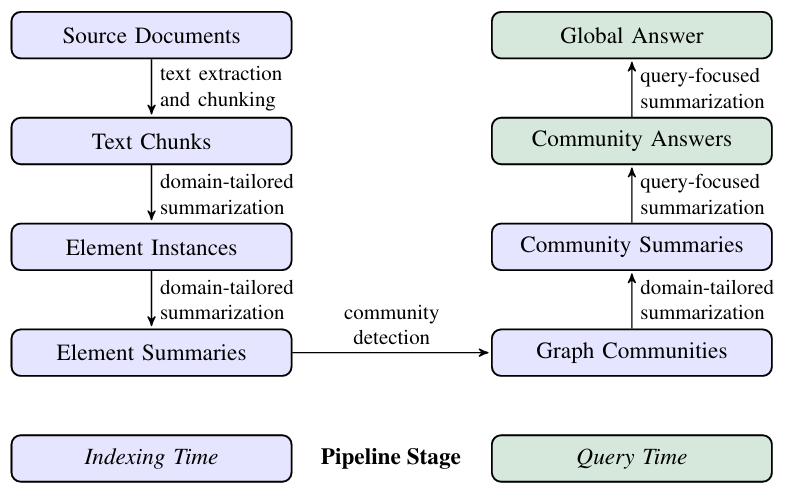
In the paper, Microsoft research used podcast transcripts and news article as the knowledge source over which retrieval is done. I decided to use a podcast episode - specifically, Dwarkesh Patel's interview with Mechanistic Interpretability researchers Trenton Bricken and Sholto Douglas.
I would expect readers to be fairly familiar with the GraphRAG paper [1].
Organizational notes
I encourage readers to probably read through the whole post and refer to this section from time to time.- For evaluation, I used one of the transcripts of Dwarkesh Patel's podcast as the knowledge source.
- During development, I used a bunch of models to test out the different components, but for the final graph index generation and inference, I used LLAMA 3.2 90B text-preview[2], provided by Groq. That being said, Gemma 9B seems to perform the best on entity-relationship extraction 1 .
- I implemented a single hierarchy of clustering graph nodes and edges.
- For the sake of optimizing for API the number of calls / requests to Groq, I implemented global search with a vectorDB, as opposed to LLM summarization in the graphrag paper. [1]
- I did not implement local search, covariates and a couple of other details that were token/api calls-expensive.
- LLM-derived Knowledge graph can be viewed here
- Link to repository. 2
Text Chunking
Dwarkesh provides
links
to the transcripts of his podcast episodes, so it was easy to get the transcripts of the episode. To preserve the notion of turn-based conversation,
I chunked the transcript text based on each speaker's speech.
Usually, the podcast transcripts are roughly structured as
More info
Speaker A (timestamp)
# Speaker A's speech
Speaker B (timestamp)
# Speaker B's speech
After chunking the
transcripts
along each speaker's speech, there were approximately 483 chunks. I analyzed the token length of each chunk.
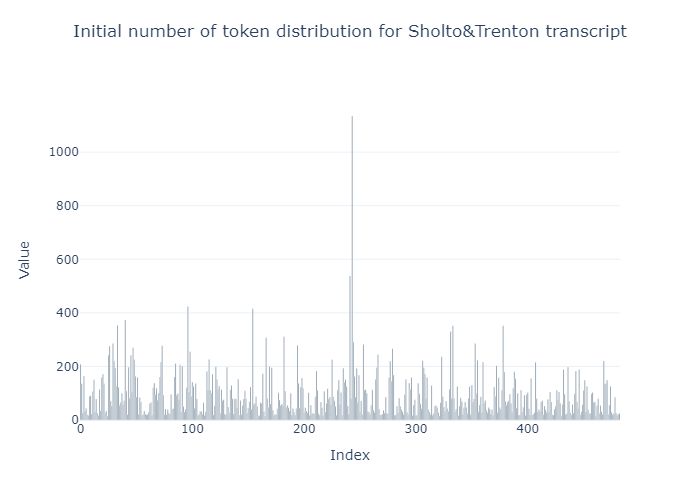
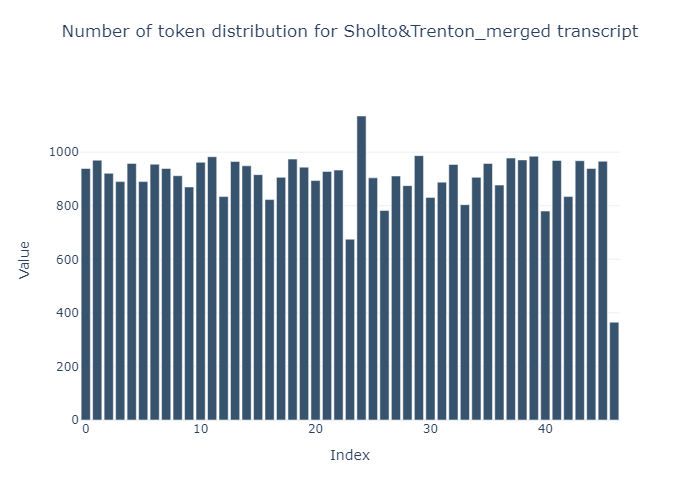
Along the lines of the original paper and for reasons I explain the next section, I decided to merge chunks, such that each chunk had an average
size of 1000 tokens
3. This reduced the number of chunks from
483 to 47.
Entity extraction
I hardcoded a list of entity types and manually asked ChatGPT to extraxt entity types from some random sample of chunks, which I then filtered for repeated entity types - this was because extracting the entity type for each chunk was expensive with respect to api calls. I ended up with a list of 33 entity types..
The entity-relationship extraction phase is in two stages.
In the first stage, I prompted the LLM to extract all the entities and relationships from each chunk and output the results in json format. For each entity, I extract the entity_name, entity_type and description. For each relationship, I extract the source entity, target entity, relationship description.
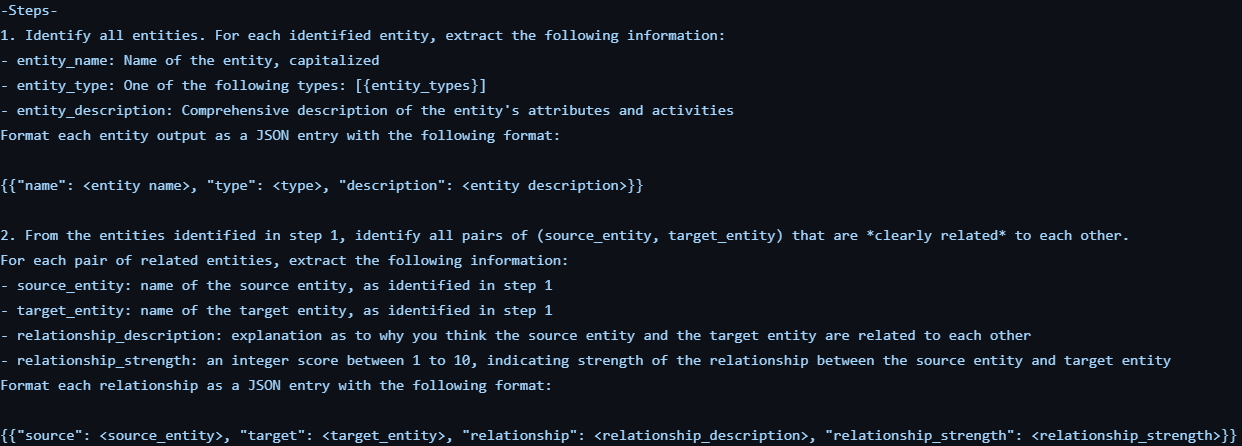
In the second stage, for each entity-relationship json retrieved for each chunk, I prompt the LLM a second time to check if it has extracted all the possible entities and relationship. The authors referred to this as gleaning 4. For most chunks, this seemed to extract almost as many relationships as it did, the first time.
A knowledge graph is then built from the entities and their relationships that have been extracted. I used the NetworkX library to construct the network graph.[3] [4]
A problem here which can be observed from the knowledge graph is that there are a bunch of entities that are not captured in any relatioship with another entity.
In practise, this means that there were two api calls per chunk. In the previous setup where I had > 450 chunks, this would have been close to 1000 api calls but now, I had less than 100 chunks for the whole document.
Graph clustering
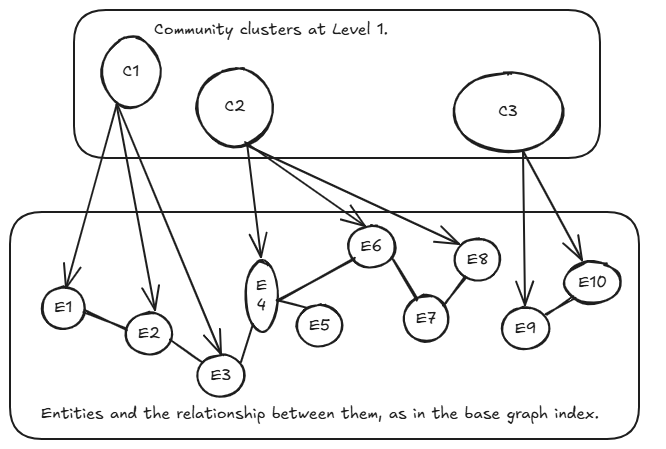
Now, we have a graph that's fairly representative of the whole document. A key insight at this stage is that we can group nodes and edges into communities which in principle should be representative of some semantic relatinoship between all the nodes in the community.
In following with the original paper, I used the Leiden algorithm
[5] provided in cdlib library to cluster the graph into
communities and I did the graph clustering for a single hierarchy level.
Community summary
My implementation here highly differs from the original implementation. To understand the decision I made, let's delve into what happens when there is a global search on a query.
In the original implementation of global search, when there is a query, an LLM is used to generate an intermediate answer and a relevance score for this query for each community summary. This requires a lot of API calls. 5
A neat thing I thought to do, was to generate a list of conclusions or mini-summaries for each community cluster. So instead of just a single community summary, there are a list of insights and conclusions for each community that are generated after the clustering process.
These conclusions are indexed in a vectorDB.
How are queries answered?
For each query, I run a similarity search with all vectors in the vectorDB from the previous section and I return 15 vectors,6 along with their similarity scores. These conclusions, their scores and the original query are then fed into the LLM for a synthesized respnse.
To also be efficient with tokens, I also implemented caching responses. This means that if a query is sent and at some time later, a similar query is sent 7, it returns the previous results. You could imagine in a large scale system where there is the potential to have a lot of duplicate queries and being able to save resources.
I did not implement conversation history.
Discussion / Final thoughts
- As mentioned in this discussion , there were some entities without relationships with other entities in the knowledge graph. My thoughts, supported by the paper is that it would be possible to extract more relationships and also entities by running more rounds of gleaning.
- The quality of the generations, from the knowledge graph to the query response would probably be better with more advanced models like GPT 4o.
- Gleaning was able to capture significantly more relationships, but more entities were also introduced to the knowledge graph. I expect that with more rounds of gleaning, this should be resolved neatly. However, it's unclear if more rounds of gleaning will be supported by the context length of the model.
- The approach of drawing insights from communities and using these insights to generate a response would add a lot of latency to the retrieval process when applied to huge datasets, such as the whole set of all Dwarkesh's podcasts 8. The rationale is, similarity search is over pieces of text which are way smaller than chunks, but for each chunk, there are 5 - 20 such texts.
- Work is not done. I plan to extend this to, at the time of this writing, ~80 Dwarkesh episodes.
Acknowledgements
- Professor Rustam Lukmanov for suggesting the project in the first place, providing feedback and the motivation to do this write-up.
- Kim Fom for useful feedback on writing good code.
- Khush Patel for some advice related to deployment of the admittedly unpolished interface and tradeoffs when choosing a vectorDB.
Footnotes
- I judged this because I have listened to the podcast episode and I was able to roughly access the quality of the generation for different models.
- I did not exactly optimise the chat interface to be a conversational agent like SOTA chat agents. Ask questions, get a response.
- In the original paper, the authors used an average size of 600 tokens.
- The prompts I used here and other parts of this implementation were largely taken from the official GraphRAG prompt tuning documentation.
- See here for the rate limits on requests and tokens per day
- The choice here is arbitrary. A more principled way would have been to use some threshold similarity score or keep adding retrieved docs to the prompt till it exceeds context length or number of tokens per query.
- or the system deems similar
- I plan to work on this sometime in the near future
References
- [1] Edge et al. (2024). From Local to Global: A Graph RAG Approach to Query-Focused Summarization. Open source ↗
- [2] AI (2024). Llama 3.2: Revolutionizing edge AI and vision with open, customizable models. Open source ↗
- [3] Trajanoska et al. (2023). Enhancing Knowledge Graph Construction Using Large Language Models. Open source ↗
- [4] Hagberg et al. (2008). Proceedings of the 7th Python in Science Conference.
- [5] Traag et al. (2019). From Louvain to Leiden: guaranteeing well-connected communities. Open source ↗